

If you’re thinking about selling your business, understanding how buyers evaluate your company’s earnings is an important first step. Two common metrics used in business valuations are Seller’s Discretionary Earnings (SDE) and EBITDA.
Both help measure financial performance, but they serve different purposes. Knowing the difference can help you better understand your business’s value and prepare for a successful sale.
What Is Seller’s Discretionary Earnings (SDE)?
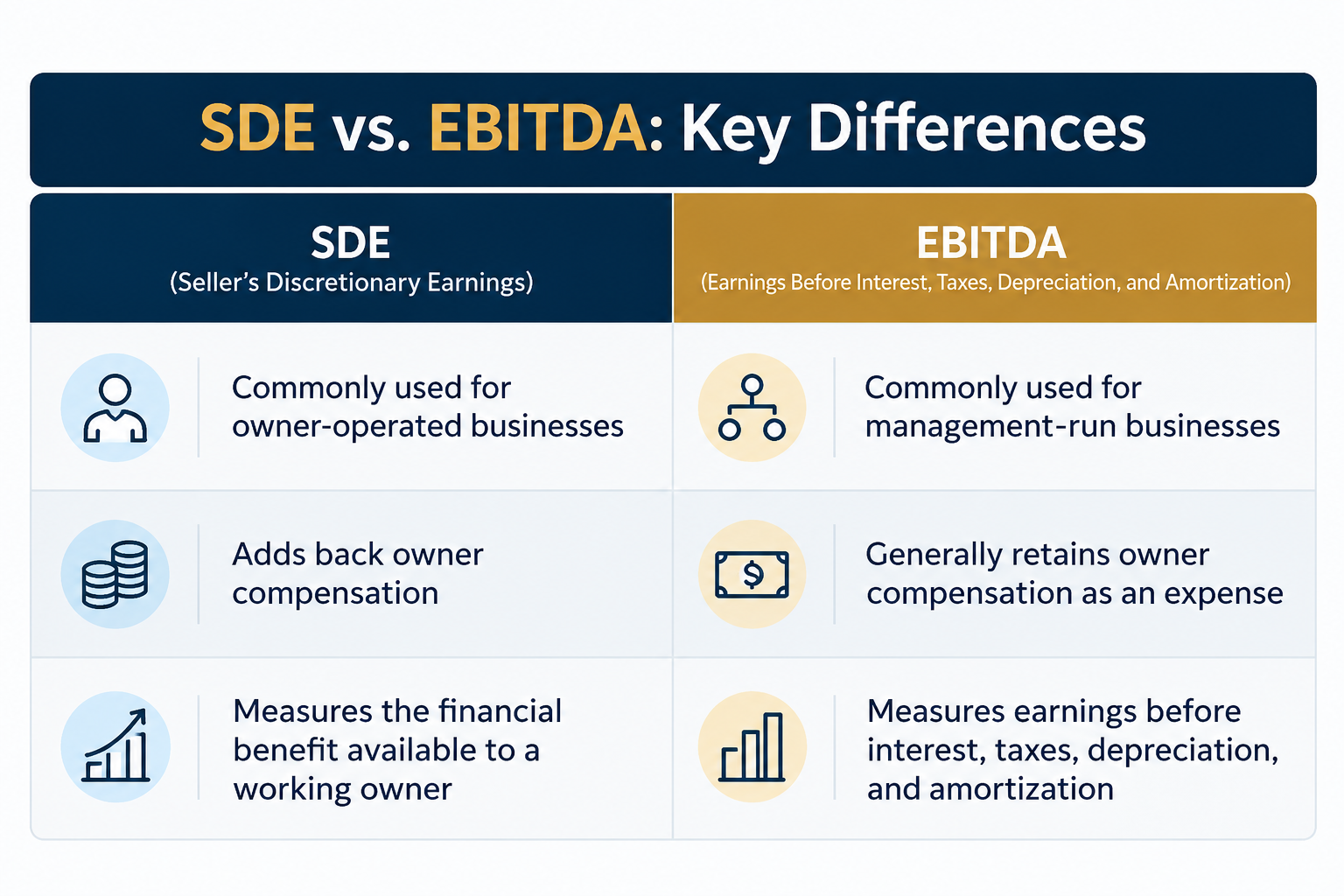
Seller’s Discretionary Earnings, or SDE, measures the total financial benefit available to one full-time owner-operator of a business.
SDE is commonly used when valuing smaller, owner-operated businesses. It typically starts with earnings and adds back owner compensation, interest, taxes, depreciation, amortization, and certain documented discretionary or one-time expenses.
Example: A business reports $150,000 in earnings, pays its owner $100,000 in compensation, and has $20,000 in eligible additional adjustments.
The estimated SDE would be $270,000.
This helps a prospective buyer understand the potential financial benefit of purchasing and operating the business.
What Is EBITDA?
EBITDA stands for Earnings Before Interest, Taxes, Depreciation, and Amortization. It measures earnings before these expenses and is commonly used when evaluating larger businesses, established management teams, and companies that may attract strategic buyers or investment groups.
Unlike SDE, EBITDA generally does not add back the owner’s compensation. The business may need to retain or hire someone to perform those responsibilities after the sale.
Using the same example, assume the $150,000 starting figure is net income and includes $100,000 in owner compensation, $5,000 in interest, $10,000 in income taxes, and $5,000 in depreciation and amortization.
The illustrative EBITDA would be $170,000, calculated by adding back interest, taxes, depreciation, and amortization without adding back owner compensation.
Actual calculations depend on the company’s financial statements and any appropriate adjustments.
Neither metric is inherently better. The appropriate measure depends on the company’s operations, financial performance, and potential buyer market.
Why Does the Difference Matter When Selling Your Business?
The earnings metric used in a valuation can influence how buyers assess your company’s financial performance and potential value.
- Valuation expectations: Earnings multiples must be applied to the correct financial metric. Using an SDE multiple with EBITDA, or vice versa, can produce misleading results.
- Buyer interest: Individual buyers planning to operate a business may focus on SDE, while strategic buyers and investment groups may place greater emphasis on EBITDA.
- Financial preparation: Organized records and documented expense adjustments help buyers understand the company’s true performance.
- Owner dependence: If the business relies heavily on you, buyers will consider who will handle your responsibilities after closing.
The goal is to present an accurate picture of your company’s earnings and understand how potential buyers may evaluate the opportunity.
Which Metric Is Right for Your Business?
There is no single rule based on company size or revenue. A smaller business with an established management team may be suited to an EBITDA analysis, while a larger company that depends heavily on its owner may require closer attention to SDE and replacement management costs.
An experienced business broker can help review your financials, identify appropriate adjustments, and determine which metrics are most relevant to your potential buyer pool.
Prepare for Your Business Sale
Understanding SDE and EBITDA can help you set realistic expectations, answer buyer questions, and prepare your company for a successful transition.
John Geiwitz, Certified Business Intermediary (CBI), helps business owners understand their options and prepare for the next stage of ownership.
Thinking about selling your business? Contact John for a confidential consultation and business valuation to better understand what your business may be worth and how to prepare for a successful exit.

